12 Shaggy Hairstyles for Women Over 50 with Thin Fine Hair

Introduction
Finding a haircut that works with your hair instead of against it changes everything — and shaggy hairstyles for women over 50 with thin fine hair do exactly that. Layers, texture, and movement are a fine-haired woman’s best friends, creating the illusion of fullness where nature kept things wispy. The modern shag isn’t the seventies rock-star mess; it’s softer, more polished, and adaptable to your face shape, lifestyle, and morning routine. Whether you’re growing out gray, dealing with a thinning crown, or craving a cut with personality, there’s a version here for you. Below, you’ll find 12 flattering ideas — from feathered collarbone cuts to choppy pixie shags — each with styling tips to make thin hair look its absolute fullest. If you’re leaning toward a shorter length, you’ll also love our guide to short shag haircuts for fine hair, which shares many of the same volume-boosting tricks.
Soft Feathered Collarbone Shag
The soft feathered collarbone shag is the sweet spot if you want to keep some length without the limpness that often comes with it. Falling right at or just below the collarbone, this cut builds in layers that flick and feather outward instead of hanging in one heavy curtain — which is exactly why it ranks among the most flattering shaggy hairstyles for women over 50 with thin hair. Layers begin around the chin and cascade down, removing just enough weight that fine strands can lift at the roots. It suits oval, round, and heart-shaped faces, and it flatters straight, wavy, or gently textured hair. The feathered pieces around the face also camouflage thinning temples beautifully while drawing the eye to your cheekbones.
- Apply volumizing mousse to damp roots before blow-drying.
- Direct a round brush upward at the crown for lift.
- Flick the ends outward with a flat iron for feathered movement.
- Refresh second-day hair with dry shampoo at the part.
Ask your stylist for long layers that start at chin level, keeping the shortest face-framing pieces no higher than the jawline — bring a photo so the feathering reads soft, not choppy. At home, work a golf-ball-sized puff of volumizing mousse through damp roots, then rough-dry upside down until your hair is about eighty percent dry before smoothing sections with a medium round brush. On day two, revive the shape with dry shampoo at the crown and a quick pass of the flat iron over just the ends. Book a trim every eight to ten weeks to keep the feathered edges crisp. The good news: this cut grows out gracefully, softening into a longer layered look rather than looking neglected if you stretch an appointment.
Layered Pixie Shag with Wispy Crown
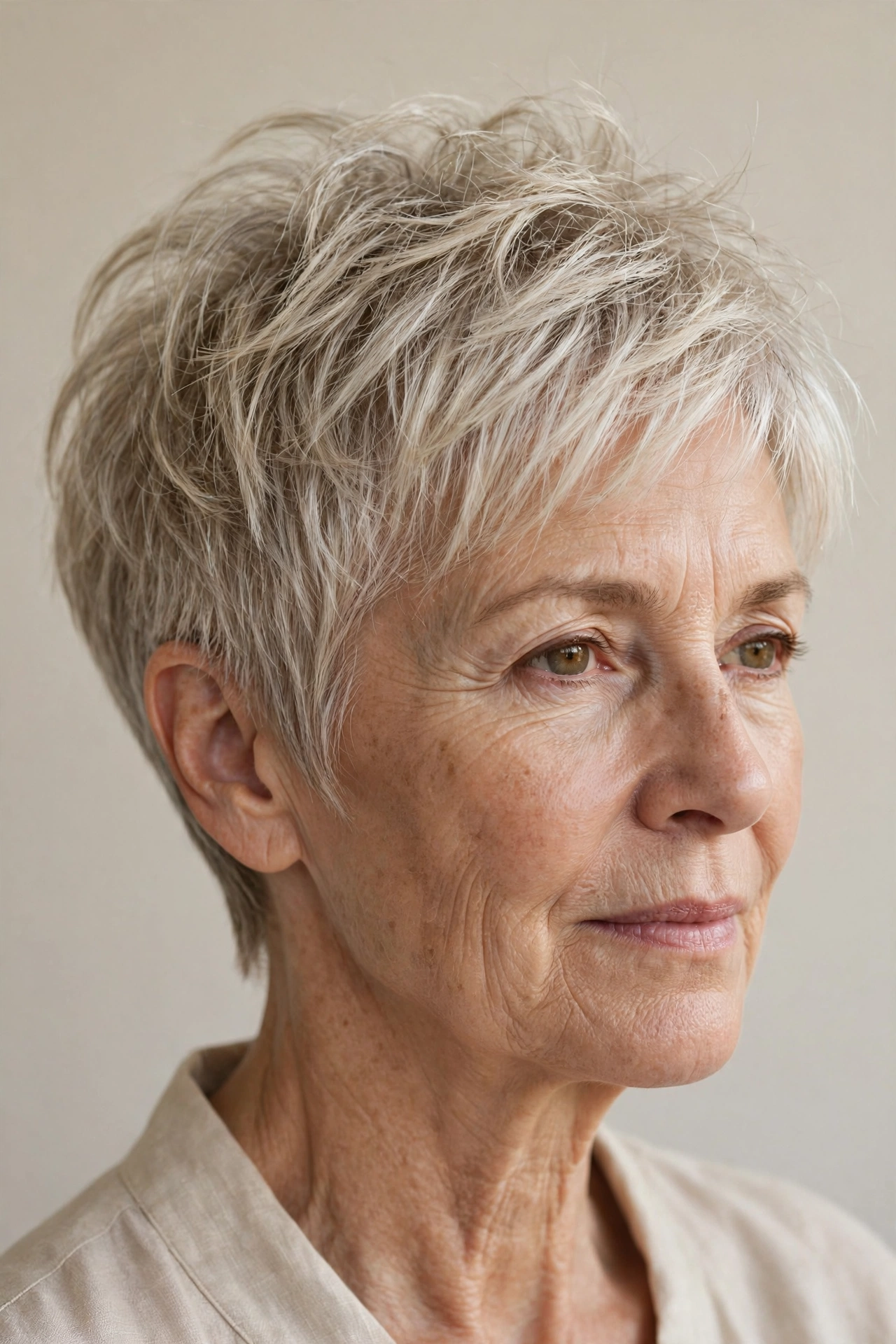
If you’re ready to go short, the layered pixie shag is a liberating choice that happens to be brilliant for fine hair. Shorter lengths mean less weight dragging your roots flat, so thin strands naturally stand up with more body. This cut keeps the nape and sides neat while leaving longer, shattered layers through the crown — and those wispy pieces on top are the secret, creating height and texture right where fine hair tends to fall limp. It suits oval, heart, and petite faces especially well, and it pairs beautifully with glasses. Because the shape is built into the cut, daily styling takes almost no effort.
- Rub a pea-sized amount of texturizing paste between palms.
- Piece out the crown layers with your fingertips for definition.
- Blow-dry the top forward, then push it back for volume.
- Tidy the nape with trimmers between salon visits.
Ask for a pixie with at least two to three inches left through the crown and point-cut, textured ends rather than a blunt finish. The nape can be tapered or slightly undercut depending on how bold you feel. Styling takes minutes: apply a lightweight styling cream to damp hair, blow-dry the crown upward and forward with your fingers, then define pieces with a dab of matte paste. For extra evening polish, tuck one side behind your ear and let the longer top sweep across. Plan a trim every five to six weeks — short shags lose their shape fast. Grow-out is simple too: the layers blend easily into a longer pixie-bob as they lengthen.
Chin-Length Textured Bob Shag

The chin-length textured bob shag gives you the polish of a bob with the playful movement of a shag — a combination that does wonders for thin, fine hair. Hitting right at the chin or jawline, the shorter length instantly makes strands look thicker, while choppy internal layers and piece-y ends stop the cut from looking heavy or helmet-like. It’s especially flattering if your face is long or narrow, because the width it creates around the cheeks balances your proportions. Straight fine hair looks sleek and piece-y here; a little natural wave turns it effortlessly tousled. The textured ends also draw attention to your smile and eyes rather than any thinning at the crown.
- Flat-iron small sections with a slight bend for piece-y texture.
- Work sea-salt spray through damp ends before air-drying.
- Tuck one side behind your ear to show off the layers.
- Keep ends hydrated with a lightweight leave-in conditioner.
Ask your stylist for a chin-length bob with internal layering and point-cut ends — emphasize texture over bluntness, but keep the baseline fairly clean so the cut holds its shape. At home, the fastest routine is a dime-sized drop of smoothing serum on damp ends, then air-drying or a quick rough blow-dry. For more definition, twist one-inch sections around a flat iron, alternating directions for that undone finish. This length shows regrowth quickly at the nape, so book trims every six to eight weeks. If you color your hair, this is a great cut for trying subtle highlights through the top layers — the dimension makes fine hair look instantly denser.
Curtain-Bang Shag for Women Over 50 with Fine Hair

Curtain bangs paired with a long shag might be the kindest combination for fine hair after fifty. The bangs — parted softly down the middle and sweeping to each side — disguise a thinning hairline and soften forehead lines, while the longer shag layers through the lengths keep the overall look current and full of movement. Because the fringe pieces are cut to blend into the face-framing layers, they never look like a harsh block; instead they melt into the cut. This style is especially flattering on round and square faces, where the vertical lines of the part and the longer layers create a slimming, elongating effect. It grows out beautifully, since curtain bangs simply become face-framing layers.
- Blow-dry bangs with a round brush, rolling each side outward.
- Pin bangs in a soft twist while they cool to set the shape.
- Use dry shampoo on the fringe to prevent midday separation.
- Trim bangs every three to four weeks to hold the length.
Ask for curtain bangs that start at cheekbone length and blend into face-framing layers, with the overall cut falling between the shoulders and mid-back. The key phrase is “soft and blended” — you want no hard lines. Style by blow-drying the bangs forward first (they dry fastest and set the tone), using a small round brush to sweep each side away from your face. If your hair is very straight, a large-barrel curling iron adds the gentle bend that keeps curtain bangs from falling flat. Between appointments, the bangs will grow — simply sweep them wider into the face frame until your next trim. This is a forgiving, low-drama cut that looks intentional even on rushed mornings.
Tousled Shoulder-Length Shag with Face-Framing Layers

This is the modern shag in its most wearable form — shoulder-length, touchably tousled, and built around face-framing layers that flatter just about everyone. The cut removes bulk through the mid-lengths while leaving enough length to feel feminine, and the deliberate messiness is genuinely functional: texture disguises thin spots and makes fine hair look like there’s simply more of it. It works beautifully on straight hair with a little wave encouraged in, on natural waves, and on hair that’s transitioning to gray, since the layers show off dimensional color. If you’ve ever felt stuck between growing your hair out and cutting it all off, this middle ground gives you movement, shape, and style without a drastic change.
- Scrunch a lightweight mousse into damp hair and air-dry.
- Twist random sections around your fingers to encourage wave.
- Flip your part to the opposite side for instant root lift.
- Finish with a flexible-hold hairspray, never a stiff one.
Ask your stylist for a shoulder-length cut with heavily textured ends and face-framing layers starting at the cheekbones. The magic words are “lived-in texture” — you want the ends thinned with point cutting so they move. Your easiest styling routine: apply mousse to towel-dried hair, scrunch, and let it air-dry, then shake out the roots with your fingers once dry. For a more polished tousle, wrap one-inch sections around a curling wand, leaving the very ends straight for that modern edge. Sleep in a loose topknot to preserve the waves overnight. Trim every eight weeks to keep the textured ends from looking stringy as they grow.
Silver Shaggy Layers for Graying Thin Hair

Going gray is a statement — and shaggy layers make sure it’s a gorgeous one. Silver and salt-and-pepper hair has incredible natural dimension, and a shag cut amplifies it: every layer catches the light differently, which creates depth that makes thin hair look far fuller than it is. The texture also solves the most common gray-hair complaint, coarseness and dryness, because shorter layered pieces are easier to keep conditioned and smooth. This cut suits every face shape, and it’s particularly striking on women who’ve fully embraced their silver. A silver shag reads modern and intentional, and you’ll spend less time in the colorist’s chair.
- Use purple shampoo weekly to keep silver bright, not yellow.
- Deep-condition weekly to combat gray hair’s natural dryness.
- Blow-dry with a heat protectant to keep layers smooth.
- Add shine serum on the ends for a polished silver glow.
Ask for the same shag structure you’d choose in any color — textured layers, piece-y ends, and face-framing pieces — and let the silver be the star. If you’re still transitioning, ask your colorist about blending the demarcation line with lowlights so the grow-out looks deliberate. At home, alternate purple shampoo with a moisturizing shampoo, since toning formulas can be drying. Style with a round brush for smoothness, or embrace air-dried texture for an edgier feel. A gloss treatment at the salon every couple of months keeps silver luminous rather than dull. The maintenance here is refreshingly simple: no root touch-ups, just trims every eight to ten weeks and good conditioning.
Side-Swept Bang Shag for Thinning Crowns

A thinning crown or widening part is one of the most common hair concerns after fifty, and a deep side part with side-swept bangs is one of the smartest ways to address it. Sweeping the hair across the head covers sparse areas at the part line while the diagonal fringe creates instant fullness across the forehead. Combined with shaggy layers through the lengths, the whole cut reads thicker and more dynamic than the hair actually is. This style flatters round and square faces in particular, since the asymmetry breaks up width and adds angles. It’s also wonderfully versatile — the bangs can be worn soft and wispy for daytime or swept more dramatically for evening.
- Part hair deeply on the fuller side while damp.
- Blow-dry bangs across the forehead with a paddle brush.
- Tease the crown lightly for extra coverage and lift.
- Set the sweep with a light mist of flexible hairspray.
Ask your stylist to establish the deep side part first, then cut long side-swept bangs that blend into the shag layers — the fringe should be longest at the cheekbone. Train your part by blow-drying it into place while damp for the first week, and it will start falling that way naturally. For daily styling, lift the crown with a round brush and direct heat at the roots in the opposite direction of the part for maximum volume, then sweep everything into place. Concealing powders or root touch-up sprays along the part line add extra camouflage on days when coverage matters most. Trim the bangs every four weeks so they keep sweeping rather than falling into your eyes.
Choppy Lob Shag with Airy Ends

The choppy lob — a long bob with shaggy attitude — is a fresh, modern choice that gives fine hair the appearance of density. Sitting between the chin and collarbone, this length is short enough to keep roots lifted but long enough to style in multiple ways. The choppiness comes from point-cutting and slicing techniques that create airy, separated ends; instead of a solid heavy baseline that can make thin hair look sparse, you get feathery texture that moves. It suits straight and slightly wavy hair best, and it flatters oval, heart, and long face shapes. There’s an effortless cool-girl energy to this cut at any age, and it photographs beautifully.
- Apply texturizing spray to dry hair and scrunch upward.
- Use a flat iron to add bends, leaving ends straight.
- Ruffle the crown with fingertips for piece-y separation.
- Avoid heavy oils that weigh down airy ends.
Ask for a lob that hits between the chin and collarbone with the ends heavily point-cut for that airy, choppy finish — request “invisible layers” through the interior so the shape stays full at the top. Style on damp hair with a volumizing spray, rough-drying with your head flipped for lift. Once dry, take random one-inch sections and add a single bend with a flat iron, alternating the direction of each bend for natural-looking texture. Finish by rubbing a tiny amount of texturizing cream between your palms and raking it through the ends only. Keep up with trims every six to eight weeks — overgrown choppy ends quickly turn stringy instead of piece-y.
Wavy Shag with Soft Perm-Like Texture

If your hair has natural wave — or you’re open to a soft modern perm — a wavy shag is pure magic for thin, fine hair. Waves create the illusion of fullness better than almost any other texture, because each bend catches light and shadow, making hair look dimensional and abundant. The shag’s layers enhance every wave, preventing the triangle shape that one-length wavy hair can fall into. This is also one of the lowest-effort options here: the cut does the work, so wash-and-go genuinely works. It suits all face shapes, and the face-framing layers can be customized to highlight your best features. If your fine hair refuses to hold a heat-styled curl, this is the answer.
- Scrunch curl-enhancing cream into soaking-wet hair.
- Diffuse on low heat or air-dry for defined waves.
- Refresh waves with a water-and-conditioner mist spray.
- Sleep in a loose pineapple ponytail to preserve texture.
Ask your stylist for long layers cut to enhance your natural wave pattern — dry-cutting is ideal here, since waves shrink and behave differently dry versus wet. If you’re considering a perm, ask specifically for a “beachy wave” or “body wave” perm with large rods; modern formulas are far gentler than the tight perms of decades past. Your routine is simple: apply curl cream to very wet hair, scrunch upward, and either diffuse or air-dry without touching it (touching creates frizz). Once fully dry, shake out the roots and separate waves with your fingers. A perm needs a trim and wave refresh every three to four months; natural waves just need regular trims every eight to ten weeks.
Tapered Nape Crop Shag

Short at the back, textured on top — the tapered nape crop shag is crisp, chic, and wonderfully practical for fine hair. The nape is cut close and tapered for a clean neckline, while the crown keeps longer, choppy layers that deliver height and movement where you need it most. Because the weight is removed from the bottom, the top layers spring up with natural volume instead of lying flat. This cut suits active women who want to look polished with minimal fuss, and it’s particularly flattering on oval and heart-shaped faces. It also frames glasses beautifully and shows off earrings, making it a quietly glamorous choice that feels modern without trying too hard.
- Apply root-lifting spray to the damp crown before drying.
- Blow-dry the top upward using just your fingers.
- Define piece-y tips with a small amount of matte wax.
- Keep the nape neat with a quick trim every four weeks.
Ask for a tapered or faded nape with length preserved through the crown — at least two inches on top so the layers have room to move. Bring reference photos showing both the back taper and the textured top, since this cut lives or dies on the balance between the two. Styling is refreshingly quick: mist root-lifter through the damp crown, blow-dry upward with your fingers for lift, then pinch small pieces with matte wax for definition. For a sleeker evening look, smooth the top with a flat iron and tuck it neatly. The tapered nape grows out fastest, so book a tidy-up every four to five weeks.
Deep Side-Part Asymmetrical Shag for Fine Hair

Sometimes the fastest route to volume is simply changing where your hair falls — and the deep side-part asymmetrical shag builds an entire cut around that trick. One side is left longer, sweeping dramatically across the forehead and cheek, while the other side is cut slightly shorter and tucked or textured close. That deep part forces the roots to lift instead of lying flat, creating instant body at the crown. The asymmetry also adds a fashion-forward edge that keeps the look youthful and intentional. It flatters round, square, and heart-shaped faces, and disguises a thinning part line since the part sits where hair is naturally denser.
- Establish the deep part on damp hair before styling.
- Blow-dry roots in the opposite direction for maximum lift.
- Sweep the long side across with a large round brush.
- Tuck the short side behind your ear for contrast.
Ask your stylist to find your natural deep part — usually aligned with the arch of one eyebrow — then cut the longer side to fall between the chin and shoulder, with the shorter side one to two inches briefer. The layers should be heavily textured so the two sides blend rather than looking disconnected. To style, apply volumizing mousse at the roots, then blow-dry the crown in the opposite direction of your part before sweeping everything into place — this trains serious lift. A flat iron can polish the longer side for a sleek contrast against the textured shorter side. Maintain the asymmetry with trims every six to eight weeks, since even growth quickly blurs the deliberate imbalance.
Long Layered Shag with Soft Face-Framing Waves

Not ready to give up your length? You don’t have to. The long layered shag keeps hair past the shoulders while using strategic layers to prevent the stringy, weighed-down look that long fine hair often suffers. Layers begin at the cheekbones and cascade through the lengths, with soft waves adding the movement and fullness that make thin hair look abundant. The face-framing pieces are the heroes here — they draw attention upward to your eyes and cheekbones and keep long hair from dragging your features down. This is a romantic, feminine option that suits oval, long, and heart-shaped faces, and it transitions beautifully if you’re growing out a shorter cut.
- Apply lightweight mousse from roots to mid-lengths.
- Curl large sections away from your face with a wand.
- Brush through waves with fingers, never a brush.
- Use dry shampoo at the roots to maintain volume.
Ask for layers that start no higher than the cheekbones, keeping the overall length past the shoulders — the goal is movement without sacrificing length. Request point-cutting through the ends so they stay soft rather than blunt. Your go-to styling: apply mousse to damp hair, rough-dry until nearly dry, then wrap two-inch sections around a large-barrel wand away from your face, leaving the ends out for a modern finish. Once cool, rake through with your fingers and mist with flexible hairspray. To protect fine long hair, sleep in a loose braid and use a silk pillowcase. Trim every ten to twelve weeks — a dusting of the ends keeps layers fresh without losing length.
Conclusion
From the soft feathered collarbone shag to the bold tapered nape crop, these ideas prove that thin, fine hair after fifty is something to work with — not against. The common thread is customization: the right shag for you depends on your face shape, your hair’s natural texture, and honestly, how much time you want to spend styling each morning. Bring photos to your stylist, be clear about your maintenance comfort zone, and don’t be afraid to ask for the cut to be adjusted as it grows. Most need only a trim every six to ten weeks and a few lightweight products — mousse, texturizing spray, and dry shampoo will take you far. Choose the version that makes you feel like yourself, and wear it with confidence. For even more inspiration, browse our haircuts for women over 70 with natural volume and textured hairstyles for women over 50 — both pair beautifully with a shag. Prefer something shorter? Our 12 pixie cuts for thin wavy hair work with your natural texture instead of against it. If you love textured layers, our 12 short layered bob hairstyles are the polished take on the look. For more cuts designed around sparse strands, our 12 hairstyles for thinning hair over 50 focus on volume illusions and easy at-home styling.




7 Comments