12 Bob with Fringe Hairstyles for Thin Fine Hair

Introduction
If your hair is fine and thin, you have probably heard that bobs and fringe are risky — that they lie flat and expose thin spots. In truth, a bob with fringe for thin fine hair is one of the most dependable ways to fake fullness: shorter cuts lift every strand at the root, and bangs add density where hair looks thinnest. The secret is the pairing: a heavy fringe collapses, while a feathered or curtain-style fringe creates movement that reads as thickness. Below: 12 bob-and-fringe combinations for delicate strands, from wispy French cuts to bold choppy bobs. If face shape also worries you, these short bob hairstyles for thin fine hair and round faces apply the same flattering principles.
The Wispy Fringe Bob for Thin Fine Hair
This timeless pairing sets a precise chin-length bob against a soft, feathered fringe — the safest entry point for first-time bangs. The bob’s clean perimeter does the heavy lifting: when every end lands at the same level, fine hair instantly looks denser. The wispy fringe is the clever counterweight — feathered rather than blunt, it softens the forehead without a heavy curtain that would lie flat. The combination flatters oval, heart, and long faces, since the fringe shortens a high forehead while chin-length ends pull attention outward. Pin-straight fine hair wears it best, needing almost no styling effort to look polished.
- Apply lightweight volumizing mousse to damp roots before blow-drying for lasting lift.
- Blow-dry the fringe side to side with a small round brush so it falls soft, never stiff.
- Finish with a pea-sized drop of shine serum on the mid-lengths, avoiding the roots.
- Refresh the fringe between washes with a pinch of dry shampoo at the roots.
Ask your stylist for a chin-grazing bob with a blunt perimeter and point-cut ends, plus a dry-cut feathered fringe sitting just below the brow line. At home, blow-dry the fringe first while damp — wet bangs set into cowlicks fast — brushing alternately left and right. Style the bob with a medium round brush, rolling sections under for a gentle curve. Book a fringe trim every three weeks, and let the full bob go six to eight weeks between cuts. When you are ready to grow the fringe out, push it to the sides and let it melt into curtain bangs with no awkward stage.
Blunt Cut Bob with Curtain Fringe

Few combinations make fine hair look instantly thicker than a one-length blunt bob, and a curtain fringe keeps the look soft and current. The magic is the perimeter: with zero layers, every strand ends at the same point, creating a solid line that reads as density even on the finest hair. The curtain fringe — parted in the center and sweeping outward — opens the face while adding coverage across the forehead, giving the thickening effect of bangs without a heavy straight-across block. Round and square faces benefit most, since the diagonal sweep softens wide cheeks and strong jawlines. It also photographs beautifully.
- Blow-dry the curtain fringe with a round brush, flicking each side outward and away.
- Flat-iron the ends in small sections, bending them slightly under for a crisp line.
- Sprinkle dry shampoo at the roots on day two to revive lift without washing.
- Part the fringe in the center while damp so the curtain falls evenly.
Ask your stylist for a one-length blunt bob ending at the chin, with a curtain fringe cut on dry hair so the natural fall shows. The fringe should be shortest at the center, around the brow, angling down to meet the bob at the cheekbones. Rough-dry the bob to eighty percent, then smooth with a paddle brush and nozzle for a glassy finish. Style curtain pieces with a large round brush or a quick outward flick of the flat iron. Keep the blunt line sharp with trims every six to eight weeks, and refresh the curtain fringe every four weeks.
Textured Bob with Choppy Micro Fringe

For an edgy look, pair a chin-length textured bob with a choppy micro fringe sitting high on the forehead. The micro fringe is the star: cut above the brows, it exposes the eyes and cheekbones, while piecey texture stops it from looking like a solid block — essential for fine hair, where a heavy short fringe would separate into thin strands. Point cutting through the bob creates flicky, separated ends that make thin hair look fuller. It suits oval and small faces and loves pin-straight hair. For more broken-up bang inspiration, browse these hairstyles with choppy bangs.
- Pinch texturizing paste through the ends to define the pieces.
- Style the micro fringe straight down with a mini flat iron for a crisp finish.
- Tousle the crown with fingertips to keep texture piecey, not fluffy.
- Skip heavy conditioner on the fringe — over-conditioned bangs separate and look thinner.
Ask your stylist for a chin-length bob with point-cut ends, plus a dry-cut micro fringe about an inch above the brows — it grows fast and needs reshaping every two to three weeks. At home, work lightweight texture cream through damp ends and rough-dry with your head flipped for root lift. The fringe needs only one pass of a mini straightener and a dab of paste through the tips. This cut forgives skipped wash days, since texture hides oil, and the micro fringe grows out naturally into a piecey brow-skimming bang, one of the easiest grow-outs on this list.
Deep Side-Swept Fringe Bob
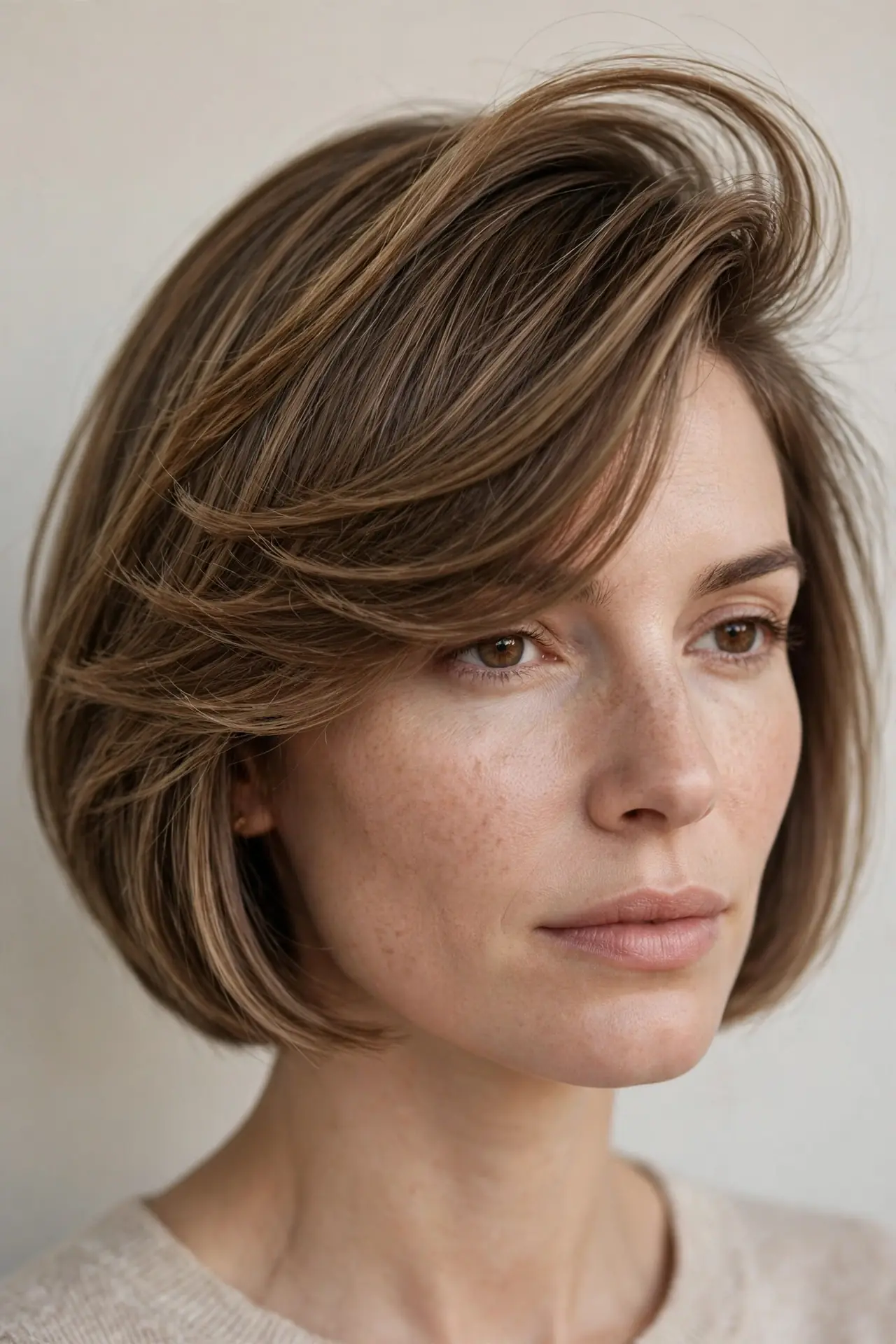
A deep side part with a long fringe swept across the forehead is a classic trick for making fine hair look abundant. The diagonal sweep creates asymmetrical crown volume — hair directed against its natural fall stands higher — and draws a long line that slims and elongates the face. Round faces love this effect, and square faces benefit too, as the sweeping line softens a strong jaw without harsh horizontal cuts. The bob stays simple, chin to jaw length with minimal layering, because the fringe carries the drama. It is also low maintenance: a side-swept fringe just gets swoopier as it grows.
- Blow-dry the fringe to the opposite side first, then flip it back for root lift.
- Set the part while hair is damp — a part placed on dry hair never sits cleanly.
- Roll the fringe in a large velcro roller while doing makeup for a lasting swoop.
- Switch your part occasionally to stop the roots from going flat on one side.
Ask your stylist for a jaw-length bob with long front layers and a fringe that angles from the part down to cheekbone length at the outer corner. Request a deep side part — at least two inches off center — so the sweep has real drama. Blow-dry the fringe against its intended direction with a medium round brush, then sweep it into place and lock it with light-hold spray. The bob needs little more than a smooth blowout with tucked-under ends. Trim the fringe every four weeks and reshape the bob every seven to eight weeks for a consistently polished result.
Layered Bob with Feathered Fringe

When fine hair falls flat, internal layering is the fix: a softly layered bob with a feathered fringe creates airy movement that makes thin hair look twice as thick. Invisible interior layers remove just enough weight for roots to lift — and lift is everything when density is low. The feathered fringe blends into the face-framing layers at the temples, so no harsh line separates bangs from bob. Long and oval faces wear this beautifully, as the movement adds width where narrow faces need it. Stringy-looking fine hair changes most, as layers replace that see-through effect with bounce.
- Ask for interior layers rather than surface layers so the perimeter stays full.
- Blow-dry with a round brush, flipping sections outward and under alternately.
- Mist lightweight volumizing spray through the mid-lengths, never at the fringe roots.
- Avoid heavy oils and butters — they collapse layered fine hair within hours.
Tell your stylist you want a chin-length bob with soft internal layers and a feathered fringe melting into the sides at the temples, cut with point-cutting for wispy ends. At home, apply volumizing mousse to damp hair and blow-dry with a medium round brush, lifting each section at the root. The fringe needs only a quick brush-through while damp and a few flicks of the round brush. Refresh the interior layers every eight weeks — overgrown layers turn stringy fast on fine hair — and trim the fringe every three to four weeks to keep it skimming the brows.
Inverted Bob with Angled Fringe
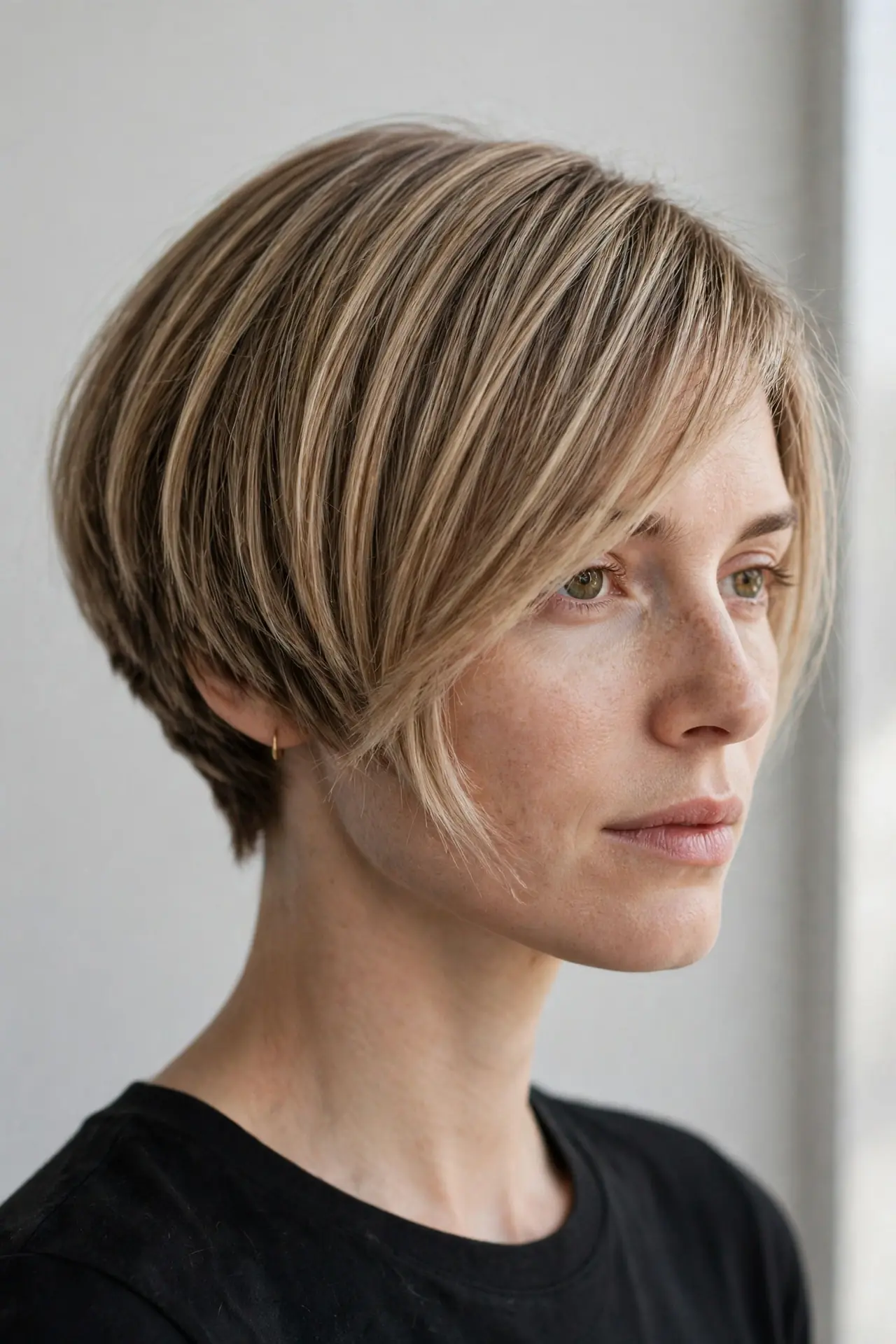
The inverted bob — shorter and stacked at the nape, sloping longer toward the front — is practically engineered for fine hair, and an angled fringe echoing that slope makes the cut feel intentional and modern. The stacked graduation at the back builds natural volume exactly where fine hair usually collapses, creating a rounded silhouette that suggests much denser hair. Longer front sections draw the eye forward and down, elongating the face, while an angled fringe mirroring the slope ties the geometry together. Round and full faces benefit most. Fine hair holds this architectural shape well, light enough for the graduation to work without bulk fighting it.
- Smooth the cut with a flat iron, bending the front sections slightly inward.
- Spritz root-lifting spray at the crown before blow-drying to maximize stacked volume.
- Style the angled fringe with the slope so it blends into the longer side.
- Tuck the shorter side behind one ear to show off the graduation.
Ask your stylist for a graduated inverted bob — stacked at the nape, sloping to collarbone-grazing length in front — with a fringe angled to blend from brow into the longer front section. Bring reference photos and confirm the angle before the first cut. Blow-dry the back with a round brush, lifting at the crown to emphasize the stack, then smooth the front lengths with a flat iron. Dry the fringe forward and slightly toward the slope. This cut shows growth quickly as the graduation softens, so book reshaping trims every six weeks to preserve the crisp inverted line and lasting crown volume.
Parisian French Bob with a Soft Fringe

The French bob — jaw-skimming, slightly tousled, with a soft brow-grazing fringe — is one of the chicest options for thin fine hair, because its short length concentrates every strand where it shows. The compact shape keeps density high from root to tip, and the strong horizontal line at the jaw makes ends look remarkably thick. The soft fringe adds Parisian insouciance while covering the forehead, cut with a light hand so it never looks heavy. Oval, heart, and petite faces wear this best. It is also forgiving: the tousled texture is the whole point, so bedhead is basically the style.
- Scrunch sea-salt spray through damp ends to encourage the tousled texture.
- Air-dry whenever possible — sleek heat styling fights the French insouciance.
- Tuck one side behind the ear for instant polish that shows off the jawline.
- Refresh the fringe with dry shampoo rather than re-wetting the head.
Ask your stylist for a bob ending at the jaw corners with minimal layering — the bluntness is the point — and a soft fringe grazing the brows, cut dry so the natural fall is honored. Request subtle point cutting through the ends so the line looks lived-in. At home, work texturizing spray through damp hair, scrunch, and walk away; this cut genuinely styles itself. If your hair is very straight, twist two or three sections while damp for a hint of wave. Trim every five to six weeks to keep the jawline sharp, and maintain the fringe every three weeks.
Long Bob with Curtain Fringe for Fine Hair

If you are not ready to go short, a collarbone-grazing long bob with a curtain fringe gives fine hair the best of both worlds: enough length for ponytails, plus fringe-driven fullness where thin hair needs it most. Collarbone length is the sweet spot — feminine, but short enough that the hair’s weight does not drag roots flat. The curtain fringe, parted in the center and sweeping into face-framing layers, adds forehead density without committing you to a straight-across bang. It suits nearly every face shape, and subtle long layers keep ends from looking wispy while preserving movement.
- Blow-dry with a large round brush, lifting at the roots and rolling ends under softly.
- Create loose waves with a large-barrel iron, alternating directions.
- Part the curtain fringe in the center while damp and let the pieces fall outward.
- Use heat protectant every time you reach for hot tools — the American Academy of Dermatology notes that limiting heat exposure helps keep delicate hair from breaking and looking thinner.
Ask your stylist for a collarbone lob with subtle long layers and a curtain fringe cut dry, parted in the middle, angling from brow to cheekbones. At home, rough-dry to eighty percent, then polish with a large round brush for smoothness with body. Add loose waves on days you want extra width — the bends create the illusion of thickness through the mid-lengths. This is the lowest-maintenance cut here: trims every eight to ten weeks keep the shape, and the curtain fringe grows out gracefully into face-framing layers, so grow-out is never awkward and upkeep stays minimal.
Asymmetrical Bob with Dramatic Side Fringe

For maximum impact, go asymmetrical: one side cut noticeably longer than the other, paired with a dramatic deep side fringe sweeping the forehead. The asymmetry is a brilliant volume illusion for fine hair — the diagonal line from short to long forces the eye to travel across the cut, and visual interest reads as fullness. The longer side forms a curtain that makes the overall shape look denser, while the dramatic fringe adds sweeping coverage and movement. Oval, square, and heart faces carry this best, since diagonal lines balance strong jawlines and wide foreheads. The result looks deliberately architectural rather than accidentally thin.
- Flat-iron in small sections so the asymmetry reads as sharp and intentional.
- Apply light shine serum to the ends only, keeping roots product-free for lift.
- Fix the deep side part with light-hold spray so the sweep survives the day.
- Style the fringe across the full forehead, the longest pieces grazing the cheekbone.
Ask your stylist for an asymmetrical bob with one to two inches of difference between the sides, plus a deep side fringe sweeping from a low side part to the opposite cheekbone. Decide together which side stays longer — it usually flatters to keep length on the side you part away from. Blow-dry smooth with a paddle brush, then flat-iron the longer side for a sleek finish. Set the fringe with a velcro roller while it cools for a lasting swoop. Because asymmetry shows growth quickly, plan trims every five to six weeks to keep the diagonal line sharp and deliberate.
Stacked Bob with Feathered Fringe

The stacked bob — graduated layers piled at the nape — was practically invented for fine hair that lies flat at the back of the head, and a feathered fringe keeps the front as soft as the back is voluminous. Each stacked layer pushes the one above it outward, building a rounded silhouette fine hair could never achieve alone. That built-in back volume is the whole game for thin hair, which typically collapses exactly there. The feathered fringe balances the architecture: wispy and textured, it softens the forehead without a heavy block up front. Round faces love the added crown height, which visually elongates.
- Blow-dry back sections with a round brush, lifting each layer away from the nape.
- Dust volumizing powder at the crown after styling for grip and lasting height.
- Style the feathered fringe with quick side-to-side strokes so it falls soft and piecey.
- Keep products away from the stacked nape — buildup flattens the graduation fast.
Ask your stylist for a stacked bob with strong graduation at the nape rising toward the occipital bone, a chin-length front, and a feathered fringe blended at the temples. Emphasize that you want visible stacking — timid graduation gives timid volume. At home, the blowout is everything: use a medium round brush on the back sections, directing hair upward to activate the stack, and smooth the front pieces under. A light volumizing spray at the roots before drying helps the shape hold. Maintain the architecture with trims every six weeks, because as the nape grows out the stack collapses and the volume disappears with it.
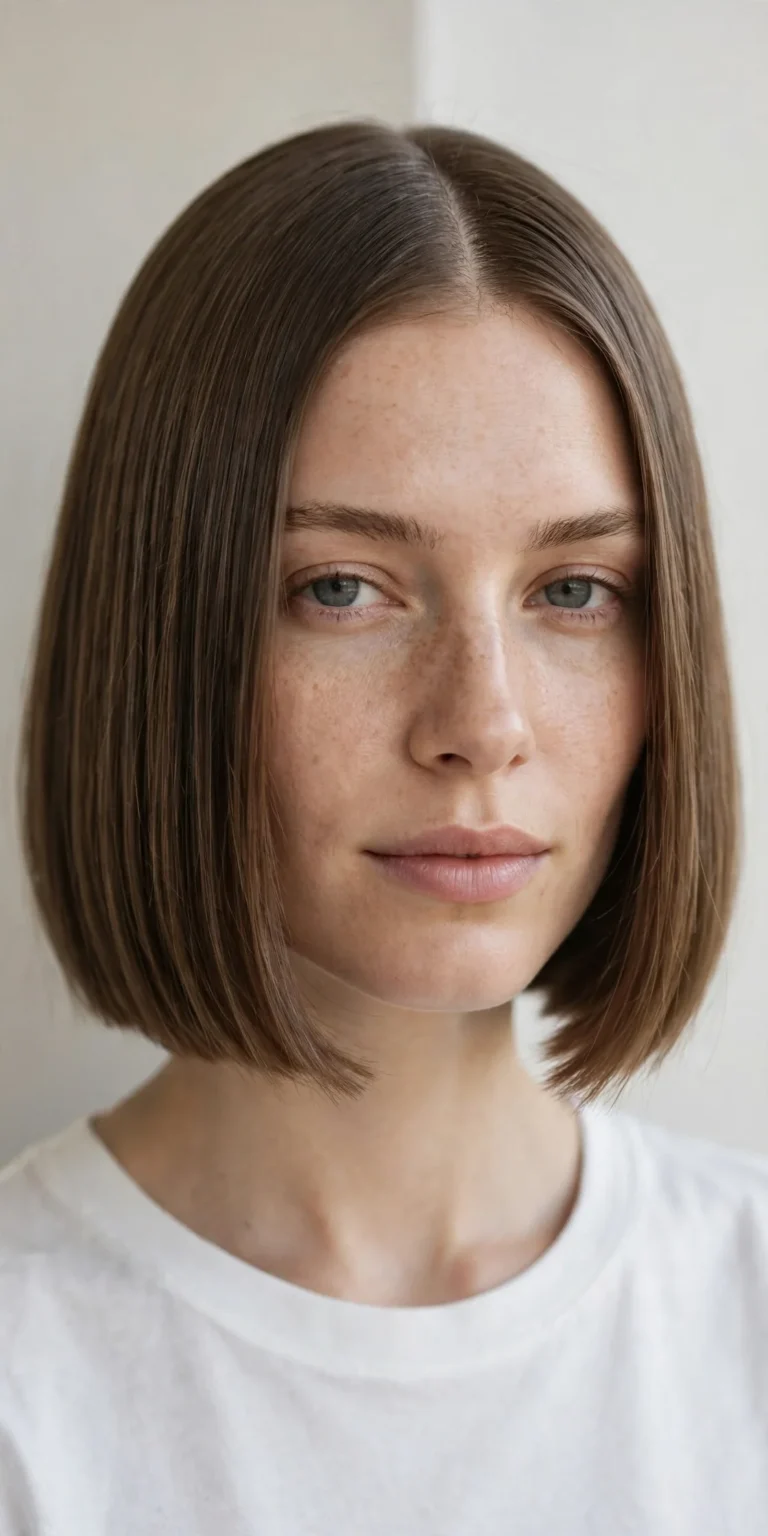
Sleek Glass Bob with Blunt Fringe

For a polished, minimal look, nothing beats the glass bob: a one-length, ultra-sleek cut with a straight-across blunt fringe, both smoothed to a mirror shine. Sleekness removes every flyaway and frizz halo that makes thin hair look sparse — what remains is a clean, reflective sheet that reads as dense and cared-for. The blunt fringe maximizes forehead coverage in one confident line, and cut precisely at the brow it frames the eyes strikingly. Long and oval faces suit this best, as the straight fringe visually shortens a longer forehead. The most precision-dependent cut here, but also the most striking.
- Flat-iron in thin sections from roots to ends for a glassy, frizz-free finish.
- Use heat protectant on every section, every time — sleek styles demand hot tools.
- Smooth a rice-sized drop of shine serum over the surface, avoiding the roots.
- Sleep on a silk pillowcase to preserve the sleek finish and reduce morning frizz.
Ask your stylist for a precision one-length bob ending at the jawline with zero layering, plus a blunt fringe cut straight across at brow level — ideally cut dry for exact placement. Request that the ends be blunt with very slight point-cutting underneath so the line looks sharp but not helmet-like. At home, blow-dry smooth with a paddle brush and nozzle, then flat-iron in small sections and finish with shine spray. The fringe needs trimming every two to three weeks to stay at brow level; the bob holds its line for six to eight weeks with minimal upkeep.
Wavy Bob with Piecey Textured Fringe

Finish with the most relaxed pairing: a wavy bob and a piecey, textured fringe that looks like a beach weekend that simply stayed. Waves are arguably the best volume trick for fine hair — every bend pushes hair outward and creates width, and width reads as thickness far more convincingly than length. The piecey fringe keeps bangs light and separated: the pieces look intentional and airy, while a heavy wavy fringe would just look frizzy. Heart, oval, and square faces wear this well, since waves soften angles and add side fullness. Wonderfully forgiving — second-day hair styles better than freshly washed.
- Wrap sections around a one-inch iron in alternating directions for undone waves.
- Mist texturizing spray through the mid-lengths and scrunch to encourage waves.
- Piece out the fringe with a little paste so strands stay separated and light.
- Revive day-two waves with dry shampoo at the roots and a quick re-wrap of the front.
Ask your stylist for a chin-to-collarbone bob with long layers to support the wave pattern, plus a piecey fringe cut with point-cutting for separated ends. The layers are non-negotiable — without them, waves fall flat on fine hair by noon. At home, apply mousse to damp hair, rough-dry, then add waves with a curling iron, leaving the very ends straight for a modern finish. Break up the waves with your fingers, never a brush. Trim every eight weeks to keep the layers bouncy, and enjoy how this cut keeps improving between wash days like few others can.
Conclusion
A great bob with fringe for thin fine hair is never about fighting your texture — it is about choosing a cut that turns fineness into an advantage, whether through a blunt perimeter that fakes density, interior layers that manufacture lift, or a fringe that brings fullness where you need it. The twelve pairings above cover every mood, from the polished glass bob to the tousled French cut, all resting on one principle: the right shape beats any product for thin hair. Take reference photos to your stylist, be honest about the styling you will do, and start gentle — a wispy or curtain fringe grows out gracefully if you change your mind. And to go shorter still, these pixie cuts for thin wavy hair prove fine strands can carry even the boldest short cuts.

One Comment